Reading Response #4
In Blindness | The Value of Images | Image Icons
4.1 In Blindness
“In Blindness", by Irena Haiduk, introduces blindness as a method of punishment in replacement of beheading since the ninth century. The author shows the importance of vision as the subject of blinding was thought to “lost all legal rights of personhood”(1) when he lost his eyes; and similarly, for the rulers, perfect vision was seen as a symbol of knowing the truth and being just. Haiduk describes different instances of using blindness throughout history - while taking over regimes, during wars, or against the rebels and the guslars.
When reading through this article, I noticed that Haiduk utilizes visual elements beyond just her text - as the reading gets blurrier page by page, her intentional use of the blurring effect emphasizes the importance of vision while adding on to her expression through text. This is something that I really like from the article, and it reminds me of the use of visual effects in concrete poetry that I have seen before. Concrete poems are defined as “objects composed of words, letters, colors, and typefaces, in which graphic space plays a central role in both design and meaning”. (Reference: “What is Concrete Poetry”)
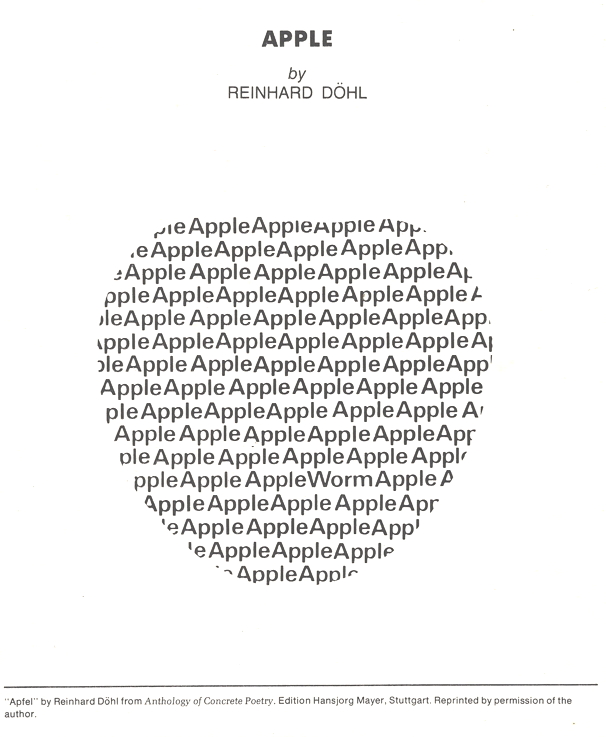
One example would be “Apple” by Reinhard Döhl, in which this German writer and artist forms a shape of an apple using the word “worm” within repeating instances of the word “apple”. It tells a story of as simple as a worm inside an apple, but adds much fun to it by using graphics for illustration.
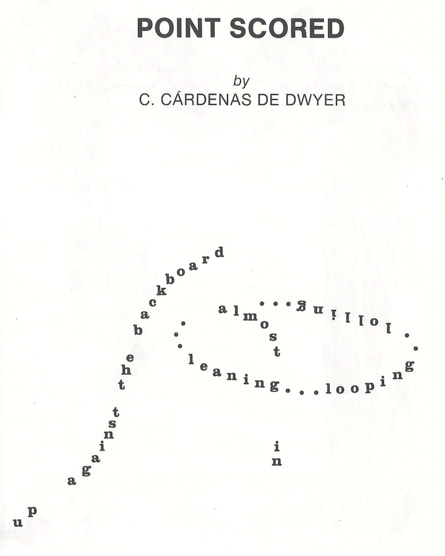
Similarly, in “The Fall” by Laura Knoll and “Point Scored” by Carlota Cárdenas de Dwyers, both authors implement the combination of art and linguistic elements to compose their poetry, exceeding the potential of the poems merely based on texts. Such use of visual elements in poetry shows the creativity and possibilities behind the art forms - compared to traditional poetry, these poets are thinking outside of the box - while effectively expressing their ideas by connecting the graphics with words, the use of visual elements allows them to intrigue the audience as well.

4.2 The value of Images / Image Icons
In the first section, “The Value of Images”, Sturken and Cartwright discuss the factors that contribute to the value of art. Images, according to the authors, “do not have value in and of themselves”; instead they are “awarded different kinds of value - monetary, social, and political - in particular social contexts” (34). For instance, the painting of irises by Van Gogh was sold for over 50 million dollars when purchased by the Getty Museum in 1991, and there are several reasons that can account for this extraordinary value: (1) it is proven authentic; (2) it is unique and representative of impressionist paintings; (3) the fame and myth of the artist; (4) it is displayed in a museum; (5) it can be reproduced for popular consumption.
In the second section “Image Icons”, the authors discuss the value of images from a different perspective as icons. They define an icon as “an image that refers to something […] that has great symbolic meaning for many people” and are often “perceived to represent universal concepts, emotions, and meanings” (36). Certain images are iconic as they become symbolic and suggest a universal meaning; an image can be said to be valuable not for the monetary value as discussed in the passage above, but because they are produced in a specific culture, time, and place, and can be interpreted for broader meanings across the world.
This is a really interesting piece that discusses the value of art beyond the aesthetics. Inspired by the reading, I decided to look up some iconic photographs. In the CNN article, “25 of the Most Iconic Photographs”, a lot of them appear very familiar to me. For example, “V-J Day in Times Square” by Alfred Eisenstaedt, which portrays a sailor kissing a woman in Times Square, has become a symbolic representation of the excitement and joy for ending WWII. This image has also been reproduced in different forms, and I remember seeing a sculpture of this when visiting San Diego. It would be considered as a valuable image, for it was taken in that specific context and conveys specific meaning.
